
The machinery industry is one of the most important application fields for modern metal-processing technology. From industrial machinery and agricultural equipment to automation equipment, construction machinery, material-handling systems, machine frames, mechanical components, and customized equipment, manufacturers need to process a wide variety of metal parts with increasing requirements for precision, strength, consistency, efficiency, and appearance. Laser equipment effectively meets the needs of the machinery industry.
At the same time, machinery manufacturers are facing several common challenges. Products are becoming more customized, production batches can vary significantly, labor costs continue to increase, and customers expect shorter delivery times without compromising quality.
Traditional processes such as conventional welding, mechanical tube cutting, drilling, grinding, and abrasive cleaning remain useful in many applications. However, these processes can involve multiple production steps, significant manual labor, heat deformation, inconsistent weld quality, and longer processing cycles.
Modern laser equipment provide machinery manufacturers with an alternative approach.
A handheld laser welding machine can provide flexible welding for customized machine components and small- to medium-batch production. An automatic laser welding machine can provide repeatable and efficient welding for standardized components and high-volume production. A laser tube cutting machine can accurately process tubes and profiles used in machine frames and mechanical structures. A laser rust removal machine can provide a non-contact cleaning solution for suitable surface preparation applications.
Sunrise Laser is a comprehensive laser equipment group integrating R&D, design, manufacturing, sales, export, and laser processing solutions. Our product range includes handheld laser welding machines, automatic laser welding machines, laser tube cutting machines, laser rust removal machines, and other industrial laser machines.
Our laser equipment is widely used in machinery, sheet metal fabrication, doors and windows, medical equipment, kitchenware and furniture, LED lighting, lithium batteries, and many other industries.
Sunrise Laser has accumulated more than 100 laser equipment patents and has served more than 10,000 customers in over 50 countries and regions.
This article explains how laser equipment can be applied throughout the machinery manufacturing process and how these technologies can help manufacturers improve welding quality, dimensional accuracy, production efficiency, repeatability, and manufacturing flexibility.
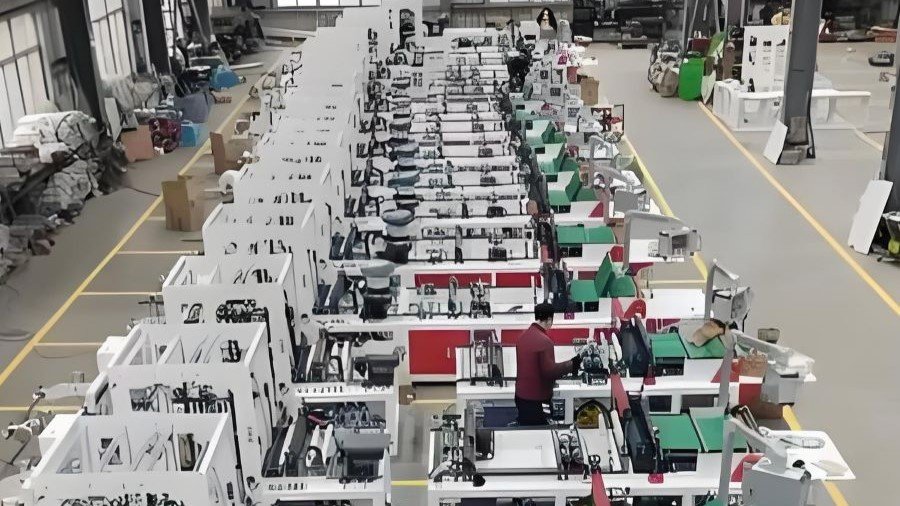
Why Laser Equipment Is Important for Machinery Manufacturing
Machinery manufacturing usually involves a complex combination of processes.
A typical manufacturing workflow may include:
Raw Material → Tube/Sheet Cutting → Drilling → Bending → Machining → Assembly → Welding → Grinding → Surface Treatment → Painting/Coating → Inspection → Final Assembly
Every stage affects the final performance of the machine.
For example, inaccurate tube cutting can cause problems when assembling a machine frame. Welding deformation can affect the geometry of a structure. An inconsistent weld can reduce structural reliability or create additional grinding work.
Machinery manufacturers therefore need processing technologies that can provide:
- High dimensional accuracy
- Stable welding quality
- Controlled heat input
- Repeatable production
- Flexible manufacturing
- High productivity
- Reduced secondary processing
Laser processing can address many of these requirements.
The core advantages of modern laser technology can be summarized as:
Precision + Speed + Repeatability + Flexibility + Automation
Handheld Laser Welding Machine for Machinery Manufacturing
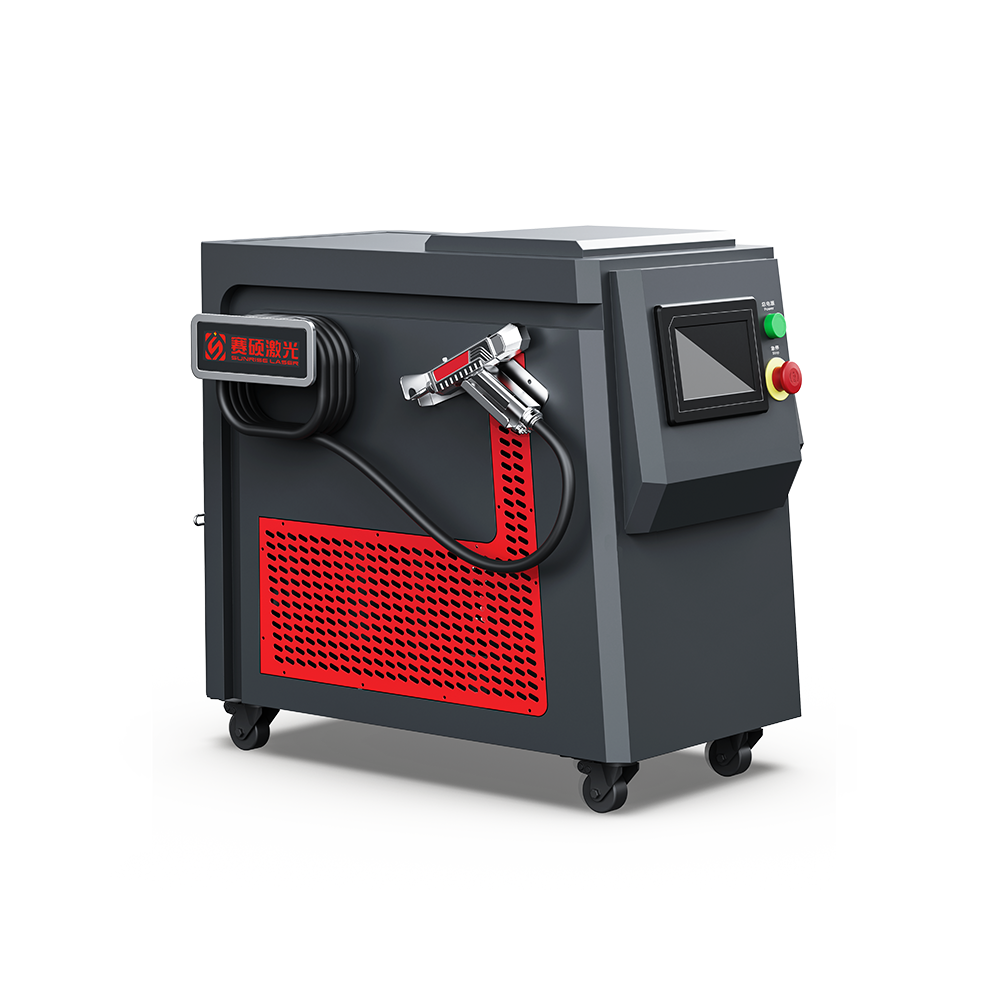
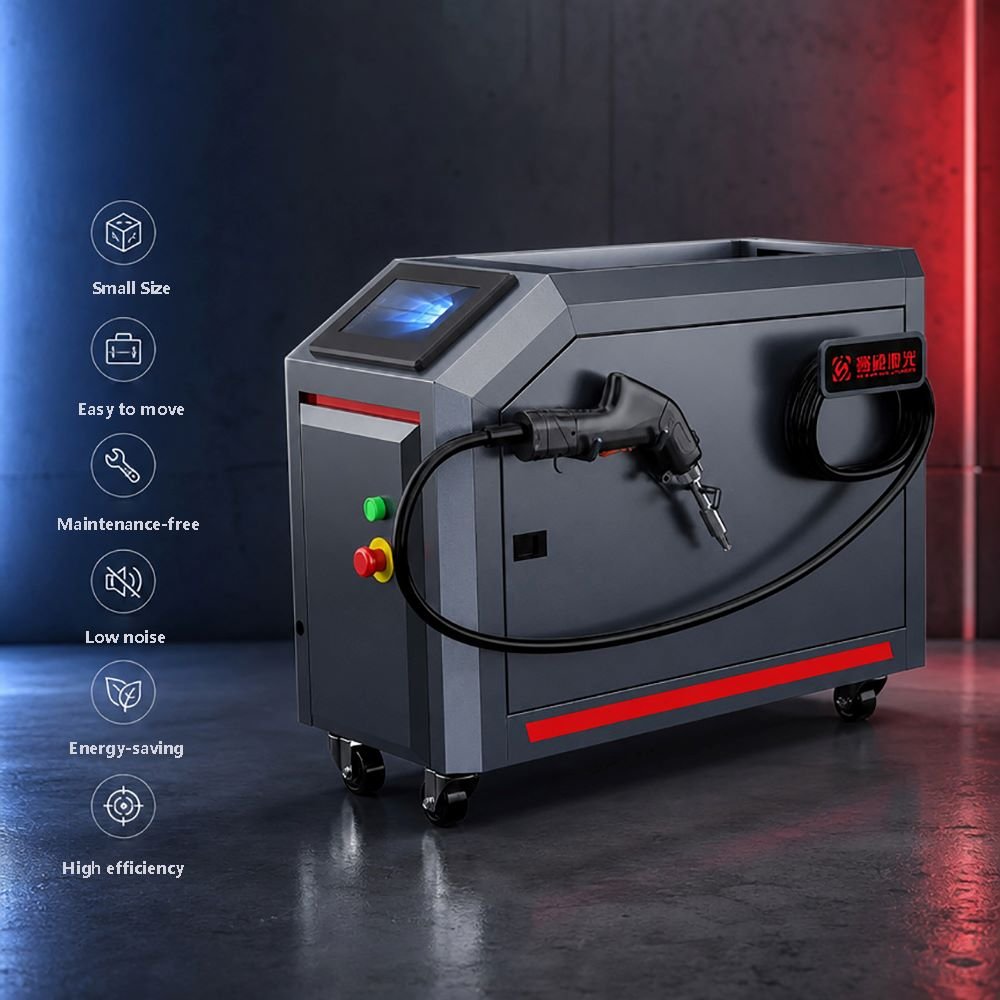
A handheld laser welding machine is one of the most flexible laser welding solutions available to machinery manufacturers.
Machinery factories rarely produce only one type of component.
A single manufacturer may produce:
- Machine frames
- Metal cabinets
- Equipment covers
- Brackets
- Structural supports
- Hoppers
- Chutes
- Pipes
- Flanges
- Guard structures
- Conveyor components
- Customized mechanical assemblies
These components can have different sizes, shapes, materials, and welding positions.
For this type of production, flexibility is extremely important.
A handheld laser welding machine allows an operator to move the welding head around the workpiece and process different welding positions.
It can be suitable for applications involving:
- Carbon steel
- Stainless steel
- Aluminum
- Galvanized components where properly prepared and controlled
- Other suitable metals
The exact laser configuration and welding parameters should always be selected according to the actual material and application.
How Handheld Laser Welding Improves Machinery Quality
1. Cleaner Welds
Machinery products are often evaluated not only by their structural performance but also by their appearance.
Machine covers, equipment frames, stainless steel components, and exposed structures may require clean and uniform welds.
For suitable joints and materials, laser welding can produce a relatively narrow and controlled weld seam.
This can help manufacturers achieve a cleaner finished appearance.
2. Reduced Heat-Affected Area
Machinery components can vary from relatively thin sheet metal to thicker structural parts.
When welding thin components, excessive heat can cause:
- Warping
- Distortion
- Misalignment
- Surface discoloration
Laser welding concentrates energy into a relatively small area.
With properly optimized process parameters, this can help manufacturers control thermal deformation.
This can be especially valuable for:
- Machine enclosures
- Sheet metal components
- Precision brackets
- Stainless steel panels
- Thin structural components
3. Reduced Grinding and Finishing
Conventional welding may require considerable post-welding grinding.
The workflow can become:
Welding → Grinding → Polishing → Cleaning → Inspection
For suitable laser-welded joints, the weld appearance can be cleaner, potentially reducing the amount of post-processing required.
This can help machinery manufacturers save both:
- Labor
- Production time
The actual amount of finishing reduction depends on the required surface quality and joint design.
Automatic Laser Welding Machine for Machinery Production
While handheld laser welding provides flexibility, many machinery manufacturers also produce standardized components in large quantities.
Examples include:
- Standard machine frames
- Repetitive brackets
- Conveyor components
- Equipment supports
- Metal cabinets
- Structural assemblies
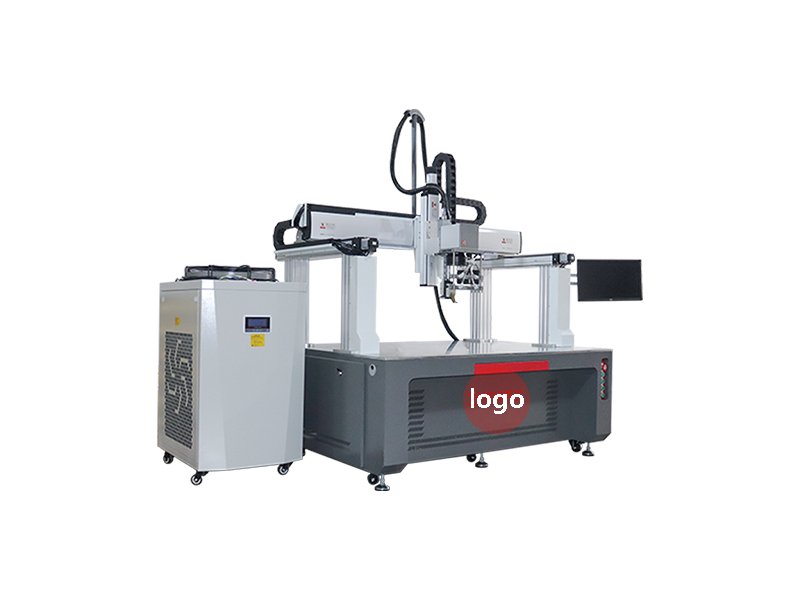
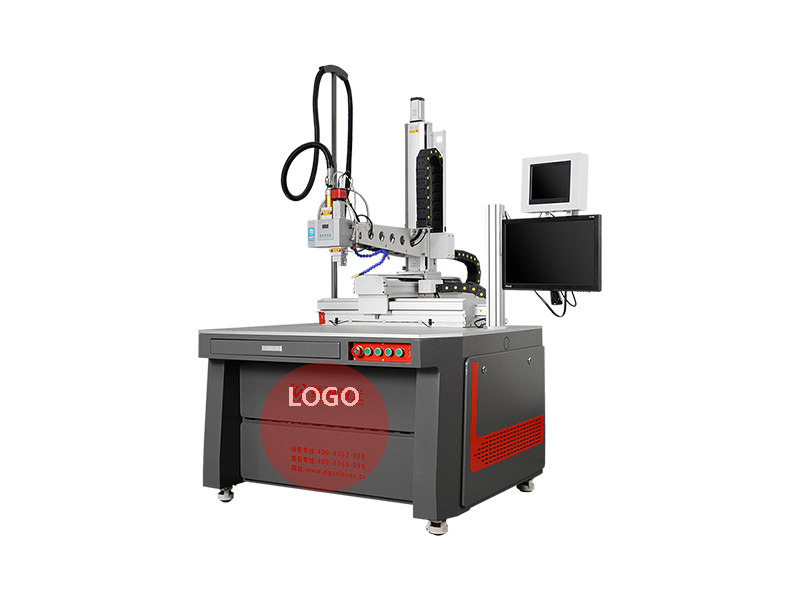
When the welding process is repetitive, an automatic laser welding machine can provide significant advantages.
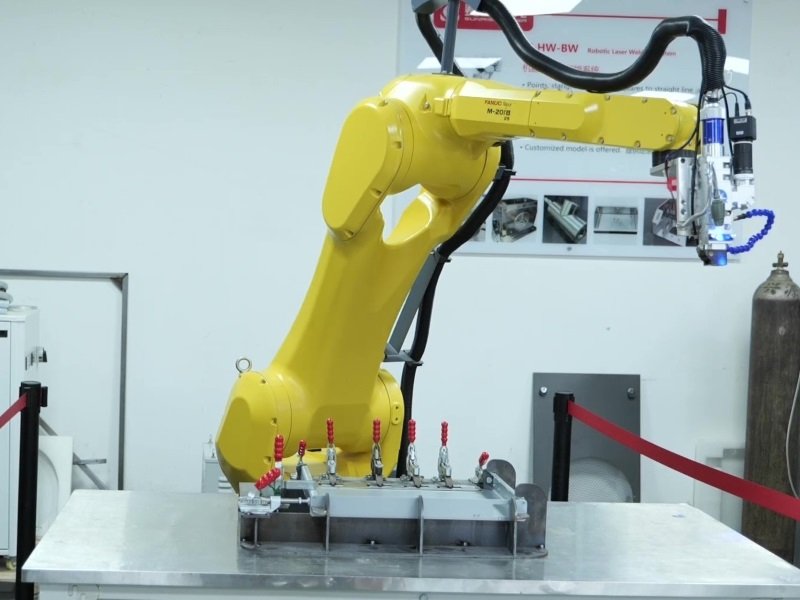
An automated laser welding system can integrate:
- CNC positioning
- Robotic arms
- Dedicated fixtures
- Automatic positioning
- Programmable welding paths
- Vision systems
- Automatic material handling
- Process monitoring
Once a welding process has been validated, the machine can repeat the programmed operation consistently.
Benefits of Automatic Laser Welding for Machinery Manufacturers
Higher Repeatability
The same welding path can be reproduced repeatedly.
Improved Production Consistency
Automated motion reduces variations caused by different operators.
Higher Productivity
Repetitive welding operations can be automated.
Reduced Manual Labor
Operators can focus on machine operation, inspection, loading, and production management.
Better Process Standardization
Validated welding parameters can be stored and reused.
Easier Automation Integration
The welding system can be integrated into larger automated production lines.
Laser Tube Cutting Machine for Machinery Manufacturing
Metal tubes and profiles are widely used in machinery.
They are commonly found in:
- Machine frames
- Conveyor systems
- Safety guards
- Structural supports
- Agricultural machinery
- Construction equipment
- Material handling equipment
- Industrial workstations
- Automation equipment
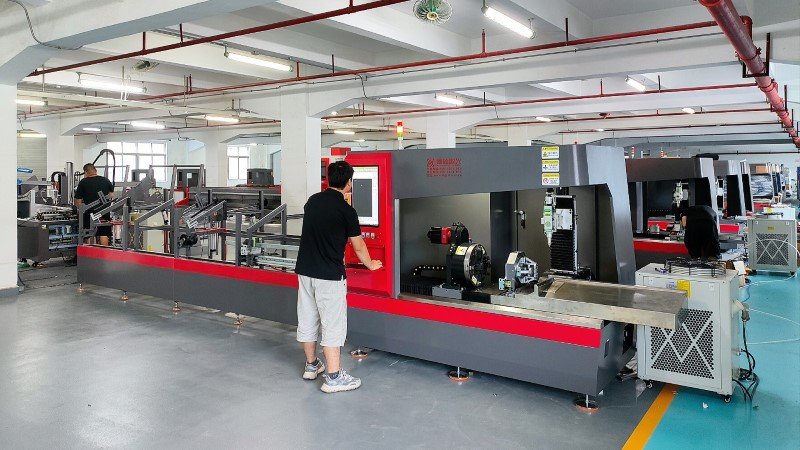
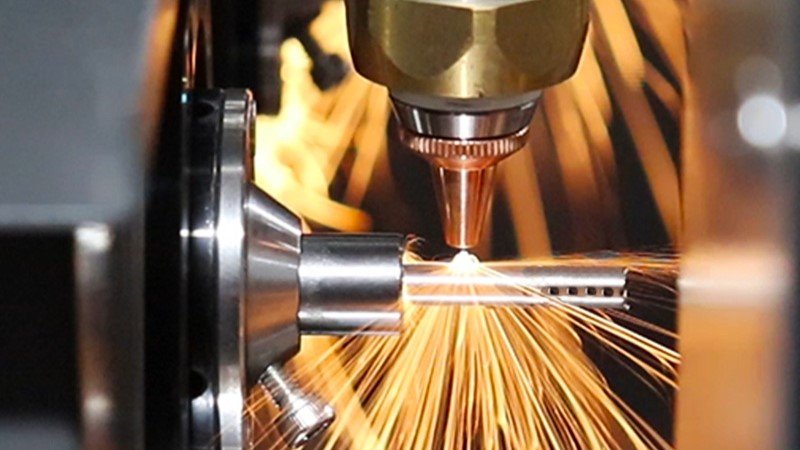
A laser tube cutting machine can accurately process suitable metal tubes and profiles.
Depending on the machine configuration, it can perform:
- Tube cutting
- Hole cutting
- Slotting
- Notching
- End cutting
- Contour processing
This can significantly simplify tube preparation.
Laser Tube Cutting vs. Traditional Tube Processing
Traditional tube processing may require multiple operations:
Cutting → Marking → Drilling → Slotting → Notching → Deburring → Inspection
Each additional operation creates:
- More machine transfers
- More labor
- More setup time
- More opportunities for dimensional errors
A laser tube cutting machine can combine multiple suitable processing operations in one CNC-controlled workflow.
This can improve both productivity and dimensional consistency.
Laser Tube Cutting for Machine Frames
Machine frames require accurate dimensions.
A frame may contain:
- Vertical tubes
- Horizontal tubes
- Cross supports
- Mounting tubes
- Brackets
- Structural profiles
If these components are not accurately manufactured, assembly becomes more difficult.
A laser tube cutting machine can produce repeatable tube dimensions and accurately position holes and other features.
This can improve:
- Frame alignment
- Assembly efficiency
- Structural consistency
- Manufacturing accuracy
Laser Tube Cutting for Conveyor Equipment
Industrial conveyors commonly use metal tubes and profiles.
They may require:
- Support frames
- Guardrails
- Cross members
- Motor supports
- Brackets
A laser tube cutting machine can produce these components with CNC-controlled processing.
For machinery manufacturers producing different conveyor sizes, digital programming also makes it easier to switch between models.
Laser Tube Cutting for Automation Equipment
Automation equipment manufacturers often produce customized machine structures.
Each project may have different:
- Dimensions
- Tube specifications
- Mounting holes
- Bracket positions
- Structural requirements
Laser tube cutting is highly compatible with this type of customized production.
Instead of manufacturing new mechanical tooling for every design, the manufacturer can modify the digital processing program.
This gives machinery manufacturers greater flexibility when responding to customized orders.
Laser Rust Removal Machine for Machinery Manufacturing
Surface treatment is another important manufacturing process.
Metal components used in machinery may develop:
- Rust
- Oxide layers
- Oil
- Grease
- Dirt
- Welding residue
- Surface contamination
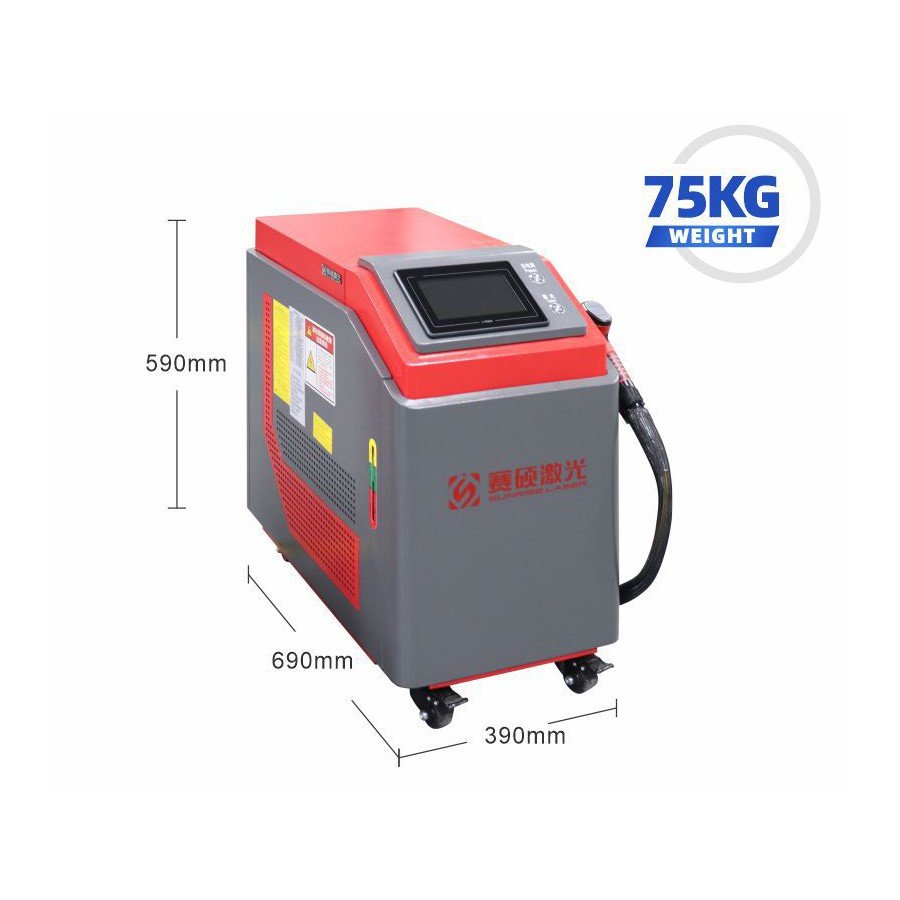
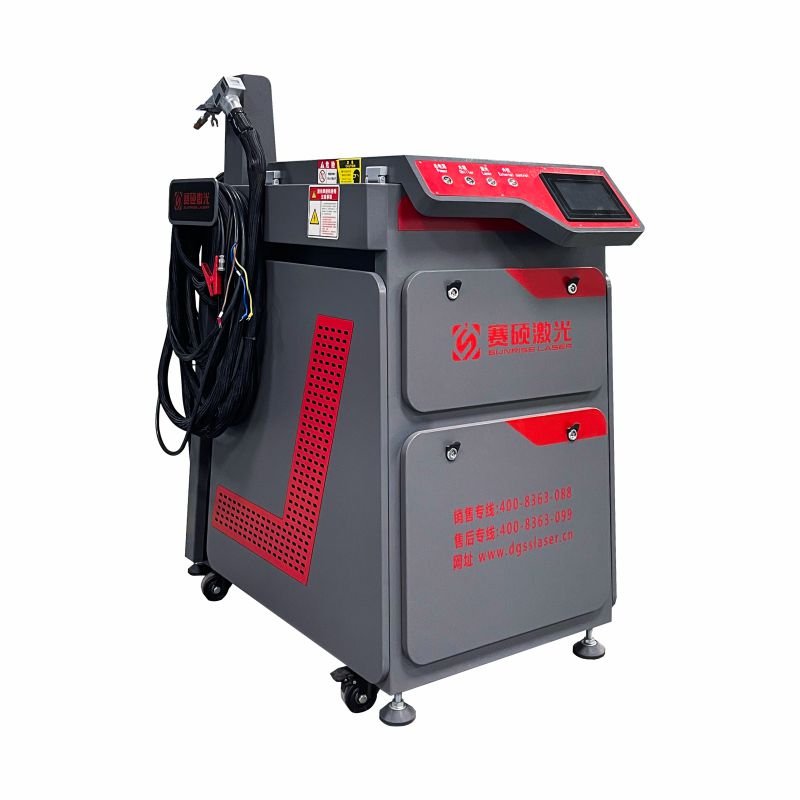
A laser rust removal machine can provide a non-contact cleaning solution for suitable applications.
Potential applications include:
- Rust removal
- Oxide removal
- Welding-area cleaning
- Oil and grease removal
- Surface preparation
- Pre-coating cleaning
- Restoration of selected metal surfaces
Laser cleaning uses controlled laser energy to remove contaminants from suitable substrates.
Why Laser Cleaning Matters for Machinery
Surface preparation can affect subsequent manufacturing processes.
For example, before painting or powder coating, contamination may reduce coating adhesion.
Before welding, oil, rust, or oxide layers may interfere with process stability.
A suitable laser rust removal machine can help manufacturers establish a more controlled surface-cleaning process.
Compared with some abrasive cleaning methods, laser cleaning is a non-contact process and does not rely on abrasive media.
However, the actual suitability of laser cleaning depends on:
- Substrate material
- Contamination type
- Surface finish
- Required cleanliness
- Laser parameters
- Processing speed
Application testing is recommended before adopting the technology for production.
Laser Welding for Machine Frames
Machine frames are often manufactured from carbon steel or stainless steel profiles.
They require:
- Accurate dimensions
- Strong joints
- Stable geometry
- Controlled deformation
A laser welding machine can provide a concentrated heat source for suitable structural welding applications.
For thin and medium-thickness materials within the machine’s processing range, laser welding can help manufacturers improve welding speed and consistency.
For larger structural components, the machine configuration and required laser power must be selected based on the actual material and thickness.
Laser Welding for Stainless Steel Machinery Components
Stainless steel is widely used in machinery because of its:
- Corrosion resistance
- Clean appearance
- Durability
- Suitability for hygienic environments
It is commonly used for:
- Food processing equipment
- Pharmaceutical equipment
- Medical equipment
- Chemical equipment
- Kitchen machinery
- Industrial equipment
A handheld laser welding machine can be used for suitable stainless steel components.
Potential applications include:
- Stainless steel frames
- Equipment cabinets
- Covers
- Hoppers
- Tanks
- Brackets
- Structural supports
For industries requiring a high-quality appearance, the relatively controlled weld produced by laser welding can be a significant advantage.
Laser Welding for Aluminum Machinery Components
Aluminum is increasingly used in modern machinery because it is lightweight and corrosion-resistant.
However, aluminum has different thermal and optical characteristics compared with steel.
Laser welding can be applied to suitable aluminum components when the system and process parameters are properly configured.
Manufacturers need to evaluate:
- Aluminum alloy
- Material thickness
- Joint design
- Laser power
- Welding speed
- Shielding gas
- Fixture design
Proper application testing is essential for production reliability.
Laser Equipment for Agricultural Machinery
Agricultural machinery contains many metal structures.
Examples include:
- Equipment frames
- Structural supports
- Hoppers
- Guards
- Brackets
- Tubes
- Hydraulic system supports
A laser machine can be used for suitable cutting and welding applications.
Laser tube cutting can help produce accurate structural components, while laser welding can join suitable metal assemblies.
For manufacturers producing different agricultural machine models, CNC laser processing also provides production flexibility.
Laser Equipment for Construction Machinery
Construction machinery requires robust metal structures.
Applications can include:
- Machine frames
- Protective structures
- Brackets
- Support structures
- Tubular components
- Covers
For suitable components, laser welding can provide controlled welding and improved production consistency.
For tubular structures, laser tube cutting can provide accurate processing of structural profiles.
However, heavy structural components may require different welding processes depending on material thickness and engineering requirements. Laser processing should therefore be selected according to the actual application rather than used universally.
Laser Equipment for Automation Machinery
Automation equipment manufacturers often face a unique challenge:
Every project can be different.
A factory may manufacture:
- Robotic workstations
- Assembly machines
- Inspection equipment
- Conveyor systems
- Packaging machines
- Automated production lines
These machines require customized frames and brackets.
Laser technology is well suited to digital manufacturing.
A CAD design can be converted into CNC cutting or welding programs.
This can reduce the need for custom mechanical tooling.
As a result, manufacturers can respond more quickly to engineering changes.
Case Study 1: Industrial Machine Frame Manufacturer
A machinery manufacturer produced steel frames for industrial equipment.
The existing welding process involved conventional welding followed by substantial grinding.
The customer faced several challenges:
- Long welding cycles
- Significant manual finishing
- Heat deformation
- Inconsistent weld appearance
- High dependence on experienced welders
Sunrise Laser evaluated the frame material, thickness, joint structure, and production requirements.
For suitable components, the customer introduced a handheld laser welding machine.
After application testing and parameter optimization, the manufacturer achieved cleaner welds and reduced the amount of post-welding grinding required.
The improvement came from the overall production workflow rather than simply increasing welding speed.
Case Study 2: Conveyor Equipment Manufacturer
A conveyor manufacturer produced large quantities of standardized support frames.
The welding structure was repetitive.
However, manual welding resulted in differences between operators.
Some frames required correction before final assembly.
Sunrise Laser developed an automatic laser welding machine solution using dedicated fixtures and programmed welding paths.
After process validation, the customer improved:
- Welding repeatability
- Frame consistency
- Production efficiency
- Operator productivity
- Assembly preparation
The automated welding system also created opportunities for future integration with material handling and inspection systems.
Case Study 3: Customized Automation Equipment Manufacturer
An automation equipment manufacturer produced customized machine frames.
Each project required different tube lengths, hole positions, and structural configurations.
The previous process required:
Tube Cutting → Marking → Drilling → Notching → Deburring
This resulted in significant manual handling.
The manufacturer introduced a laser tube cutting machine.
The new process allowed suitable cutting, hole-making, and profile-processing operations to be performed in a CNC-controlled workflow.
The customer improved:
- Tube processing accuracy
- Production flexibility
- Processing efficiency
- Component consistency
- Customized order response
Case Study 4: Machinery Component Surface Cleaning
A machinery manufacturer needed to remove rust and surface contamination from selected metal components before subsequent processing.
The traditional method relied on manual abrasive cleaning.
This created:
- Dust
- Consumable usage
- Manual labor
- Inconsistent cleaning results
The customer introduced a laser rust removal machine for suitable applications.
The laser cleaning process provided non-contact surface treatment for selected components.
This helped the manufacturer establish a more controlled cleaning workflow while reducing reliance on some conventional abrasive cleaning operations.
How Laser Equipment Improves Machinery Product Quality
The quality advantages of laser processing can be summarized across several stages.
Accurate Tube Processing
CNC laser tube cutting provides repeatable dimensions for suitable components.
Controlled Welding
Laser welding provides a concentrated heat source and programmable welding paths.
Reduced Thermal Distortion
Properly optimized laser welding can help control deformation.
Consistent Production
Automatic laser welding reduces operator-dependent variation.
Better Surface Preparation
Laser cleaning provides a non-contact cleaning option for selected applications.
Together, these advantages can improve the consistency of machinery components and assemblies.
How Laser Machines Improve Machinery Production Efficiency
For machinery manufacturers, efficiency should be evaluated across the complete production process.
Laser equipment can improve efficiency by:
Reducing Processing Steps
Multiple suitable tube-processing operations can be integrated into a laser tube cutting workflow.
Reducing Manual Handling
Fewer transfers between machines can reduce labor requirements.
Increasing Welding Productivity
Laser welding can provide high welding speeds for suitable applications.
Reducing Post-Processing
Cleaner welds can reduce grinding requirements in appropriate applications.
Improving Repeatability
Automated laser systems can repeatedly execute validated programs.
Supporting Customized Manufacturing
Digital programs make product changes easier.
Handheld Laser Welding Machine vs. Automatic Laser Welding Machine
Machinery manufacturers should select the welding system according to their production requirements.
| Requirement | Handheld Laser Welding Machine | Automatic Laser Welding Machine |
|---|---|---|
| Customized machinery | Excellent | Suitable with flexible automation |
| Small batches | Excellent | Suitable |
| Medium batches | Excellent | Excellent |
| Mass production | Suitable | Excellent |
| Many product models | Very flexible | Depends on system design |
| Repetitive welding | Good | Excellent |
| Automation | Low–medium | Medium–high |
| Operator flexibility | Very high | Lower |
| Repeatability | High with trained operators | Very high |
| Product changeover | Fast and flexible | Depends on fixture design |
A customized machinery workshop may benefit more from a handheld laser welding machine.
A factory producing standardized machine components at high volume may benefit more from automatic laser welding.
Some manufacturers can use both systems for different production requirements.
How to Choose a Laser Equipment Manufacturer
Choosing a laser equipment manufacturer is an important decision.
Manufacturers should evaluate more than machine specifications.
Important considerations include:
R&D Capability
Can the supplier develop customized equipment?
Manufacturing Capability
Does the supplier have adequate production facilities and quality control?
Application Experience
Does the supplier understand your industry and actual processing requirements?
Equipment Range
Can the supplier provide welding, tube cutting, cleaning, and other relevant laser equipment?
Testing Capability
Can the supplier test your actual workpieces?
Technical Support
Does the supplier provide installation, commissioning, training, and after-sales support?
Customization
Can the supplier modify machine configuration according to production requirements?
These factors can have a significant impact on the long-term value of your laser investment.
Why Choose Sunrise Laser as Your Laser Machine Manufacturer?
Sunrise Laser is a comprehensive laser machine manufacturer integrating:
R&D + Design + Manufacturing + Sales + Export + Laser Processing Solutions
Our laser equipment portfolio includes:
- Handheld Laser Welding Machine
- Automatic Laser Welding Machine
- Laser Tube Cutting Machine
- Laser Rust Removal Machine
- Industrial Laser Machine
- Customized Laser Equipment
Sunrise Laser has accumulated more than 100 laser equipment patents.
We have served more than 10,000 customers across 50+ countries and regions.
Our laser machines are widely used in:
- Machinery
- Sheet metal
- Doors and windows
- Medical equipment
- Kitchenware
- Furniture
- LED lighting
- Lithium batteries
- Hardware manufacturing
For machinery manufacturers, Sunrise Laser can evaluate the customer’s:
- Material
- Thickness
- Product dimensions
- Welding structure
- Tube specifications
- Production volume
- Automation requirements
- Surface treatment requirements
Based on these factors, our engineering team can recommend a suitable laser processing solution.
This is particularly important because the best laser machine is not necessarily the machine with the highest power.
The best laser machine is the one that matches the actual manufacturing process.
Application Testing: A Critical Step Before Purchasing Laser Equipment
Before purchasing a laser welding machine or other laser equipment, machinery manufacturers should conduct application testing.
Testing can evaluate:
- Welding penetration
- Weld appearance
- Welding speed
- Heat deformation
- Cutting accuracy
- Hole quality
- Surface-cleaning performance
- Production cycle
- Post-processing requirements
For welding applications, testing should use actual production materials whenever possible.
The manufacturer should also evaluate the complete process rather than judging the machine based on one test weld.
For example:
Laser Welding → Grinding → Cleaning → Coating → Assembly
The real production benefit should be evaluated across the complete workflow.
Laser Equipment and Smart Machinery Manufacturing
The future of machinery manufacturing is moving toward smart manufacturing.
Modern factories increasingly integrate:
- CNC systems
- Robots
- Machine vision
- Automated material handling
- Digital production management
- Automatic inspection
- Process monitoring
Laser machines can become an important component of this ecosystem.
An advanced production workflow could be:
CAD Design
↓
CNC Tube Cutting
↓
Automatic Positioning
↓
Automatic Laser Welding
↓
Vision Inspection
↓
Surface Treatment
↓
Final Assembly
This approach can help machinery manufacturers improve production traceability, repeatability, and efficiency.
The Future of Laser Technology in the Machinery Industry
Several major trends are shaping machinery manufacturing:
Greater Automation
Manufacturers are increasingly replacing repetitive manual operations with automated systems.
More Customized Products
Customers increasingly expect machinery designed around their specific production requirements.
Higher Precision
Modern machines require increasingly accurate components.
Shorter Delivery Times
Manufacturers must respond quickly to customer orders.
Digital Manufacturing
CAD/CAM, CNC systems, robotics, and intelligent production management are becoming more integrated.
Laser technology fits naturally into these trends.
A laser tube cutting machine supports digital component manufacturing.
A handheld laser welding machine provides flexible welding.
An automatic laser welding machine supports repetitive mass production.
A laser rust removal machine provides a modern surface-cleaning option.
Together, these technologies can help machinery manufacturers build a more flexible and efficient production system.
Laser equipment enhances mechanical quality
Laser technology is becoming increasingly important in modern machinery manufacturing.
From machine frames and automation equipment to conveyors, agricultural machinery, construction machinery, industrial equipment, and customized mechanical structures, laser equipment can improve multiple manufacturing processes.
A handheld laser welding machine provides flexibility for customized machinery and small- to medium-batch production.
An automatic laser welding machine provides repeatability and productivity for standardized manufacturing.
A laser tube cutting machine provides accurate CNC processing of tubes and profiles used in machine frames and structural components.
A laser rust removal machine provides a non-contact cleaning option for suitable rust, oxide, oil, grease, and surface-contamination removal applications.
When properly selected and integrated, these laser machines and laser equipments can help machinery manufacturers achieve:
- Better welding quality
- Higher dimensional accuracy
- Reduced thermal deformation
- Lower secondary-processing requirements
- Higher production efficiency
- Better process consistency
- Greater manufacturing flexibility
- Improved automation capability
However, laser technology should not be treated as a one-size-fits-all solution.
The correct equipment must be selected according to material, thickness, joint structure, product geometry, production volume, quality requirements, and automation goals.
Sunrise Laser combines R&D, design, manufacturing, sales, export, and application engineering to provide industrial laser solutions for manufacturers worldwide.
With 100+ laser equipment patents, more than 10,000 customers, and customers across 50+ countries and regions, Sunrise Laser has accumulated extensive experience in industrial laser applications.
For machinery manufacturers seeking to upgrade welding, tube processing, surface cleaning, or production automation, Sunrise Laser provides handheld laser welding machines, automatic laser welding machines, laser tube cutting machines, laser rust removal machines, and customized laser equipment solutions.
Modern machinery manufacturing is not simply about producing machines faster. It is about producing more accurate, reliable, consistent, and cost-effective machines. With the right laser equipment and a properly engineered process, manufacturers can build a stronger foundation for the next generation of industrial manufacturing.
Frequently Asked Questions About Laser Equipment for the Machinery Industry
What laser equipment is commonly used in machinery manufacturing?
The main laser solutions include handheld laser welding machines, automatic laser welding machines, laser tube cutting machines, and laser rust removal machines. The appropriate combination depends on the machinery product, material, production volume, and automation requirements.
What is a handheld laser welding machine used for in machinery manufacturing?
A handheld laser welding machine can be used for suitable machine frames, brackets, cabinets, equipment covers, structural components, pipes, and customized mechanical assemblies. It is especially useful for flexible and small- to medium-batch production.
When should a machinery manufacturer use an automatic laser welding machine?
Automatic laser welding is particularly suitable when the manufacturer produces standardized components with repetitive welding paths and relatively stable production volumes. Automation can improve repeatability and reduce repetitive manual work.
Can a laser tube cutting machine process machine frames?
Yes. A suitable laser tube cutting machine can process round, square, rectangular, and other compatible metal tubes and profiles used for machine frames, conveyor systems, safety guards, structural supports, and automation equipment.
Can laser welding reduce deformation in machinery components?
For suitable materials and joint designs, the concentrated heat input of laser welding can help control thermal deformation. The actual result depends on material, thickness, joint design, laser parameters, and fixture configuration.
Can laser welding be used for stainless steel machinery?
Yes. Laser welding can be applied to suitable stainless steel components, including machine frames, equipment covers, cabinets, hoppers, brackets, and structural components.
Can laser equipment be used for aluminum machinery?
Yes, suitable laser systems can process aluminum components. Because aluminum has specific thermal and optical characteristics, manufacturers should conduct application testing and optimize laser power, speed, shielding gas, and joint design.
What is a laser rust removal machine used for in machinery manufacturing?
A laser rust removal machine can be used for suitable rust, oxide, oil, grease, welding residue, and surface-contamination removal applications. It can also support selected pre-welding and pre-coating surface preparation processes.
How can laser equipment improve machinery production efficiency?
Laser equipment can reduce processing steps, minimize manual handling, increase suitable welding and cutting speeds, reduce secondary finishing, improve repeatability, and support automated production.
Why should machinery manufacturers test laser equipment before purchasing?
Different materials, thicknesses, joint designs, and production requirements produce different laser-processing results. Testing actual workpieces helps determine whether the proposed laser machine and process parameters can meet the manufacturer’s quality and productivity requirements.
Why choose Sunrise Laser as a laser equipment manufacturer?
Sunrise Laser integrates R&D, design, manufacturing, sales, and global export. With 100+ laser equipment patents and more than 10,000 customers across 50+ countries and regions, Sunrise Laser provides handheld laser welding machines, automatic laser welding machines, laser tube cutting machines, laser rust removal machines, and customized industrial laser solutions.
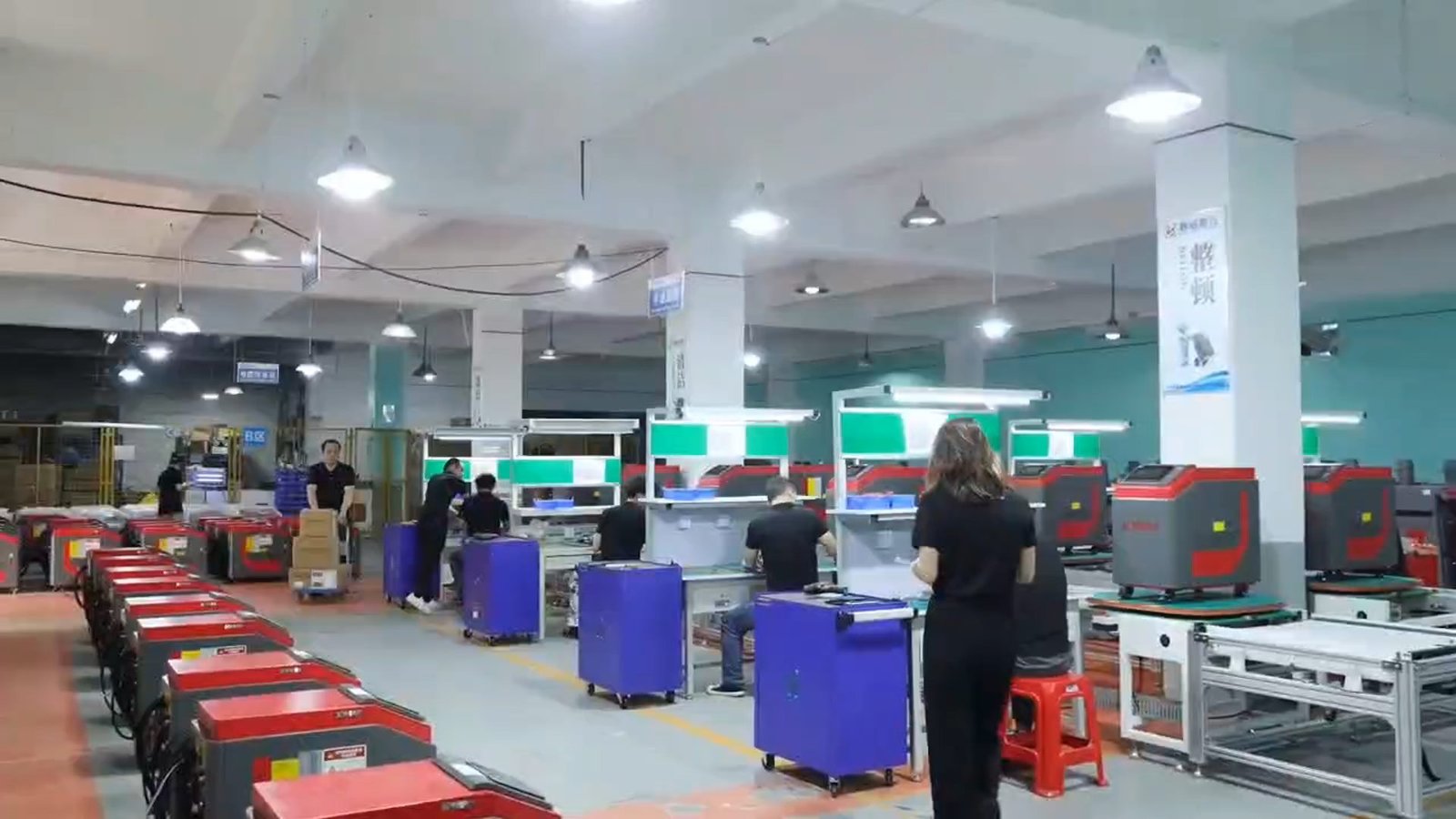
We have a leading laser welding machine factory of skilled engineers ready to support you in your product development journey from idea design to production.Any ideas about your product you can contact us freely,and our engineers will get back to you with a quote asap. WhatsApp: +86 198 5408 2298
Who is Sunrise laser?
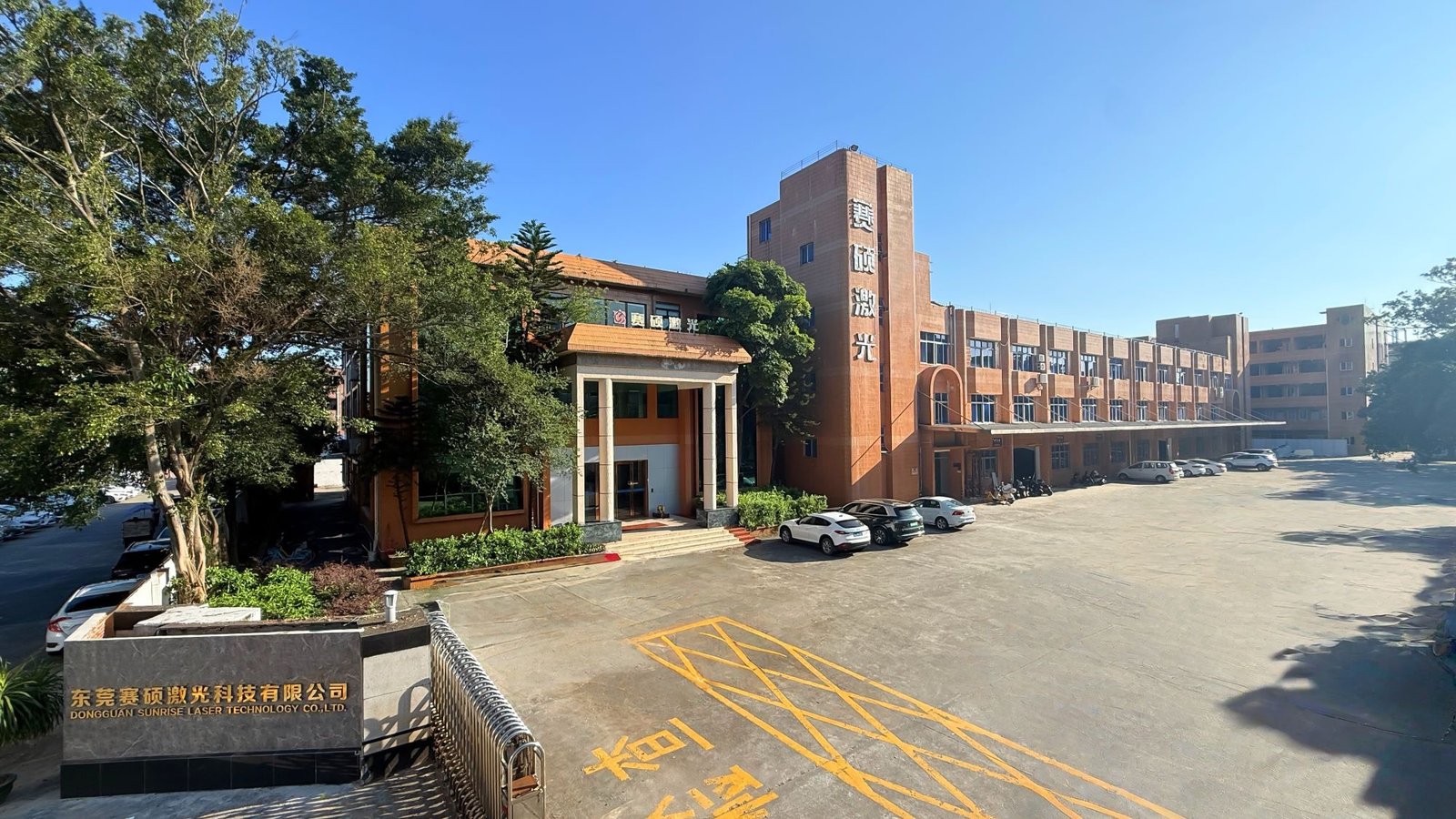
Dongguan Sunrise Laser Technology Co, Ltd. was established in 2016 with a registered capital of CNY 20.210,000 and a modern productionase of 11,000+㎡. It is a professional manufacturer dedicated to the research and development, production, and sales of high-end laser welding machine,laser tube cutting machine.
What is your product range?
We pecialize in the design and production of high quality laser machines,such as laser welding machine,laser tube cutting machine, laser rust removal machine…
Do you have any international certifications?
We have passed ISO 9001, CE, RoHS, SGS and other certifications, and meet the mainstream standards of Europe, America, the Middle East and Asia.
What is the technical background of your team?
10-person R&D team (5 senior engineers) + 50-person production team, with an average of 8 years of experience and 100% certification rate.
Can I have my custom logo , design or size?
Sure. We support OEM and ODM services, allowing for the customization of appearance, power, dimensions, and your logo according to your requirements.You can view the OEM&ODM service page. https://sunriselasertech.com/oem-odm/

 English